
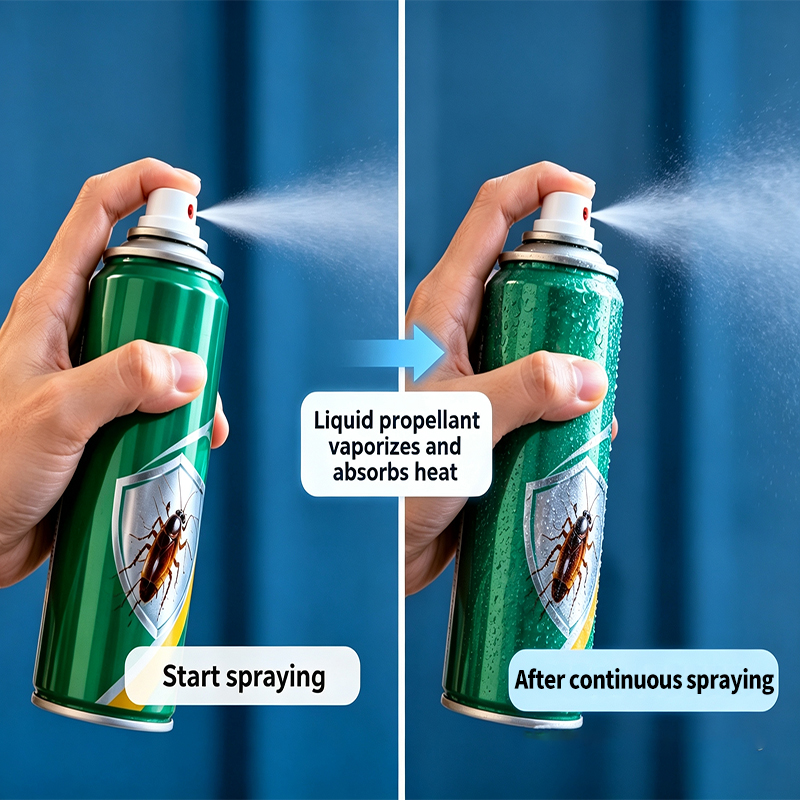
Have you ever noticed something strange? Pick up a can of insecticide spray — Pssst — spray for a couple of seconds, nothing much. Keep going: psssst—— and wait, why is the can getting colder and colder? If you spray continuously for long enough, the can may feel icy cold, with a layer of tiny water droplets forming on its surface.
Then a bold thought crosses your mind: if I keep spraying like this… could it actually freeze?
Why Does the Aerosol Can Get Colder as You Spray?
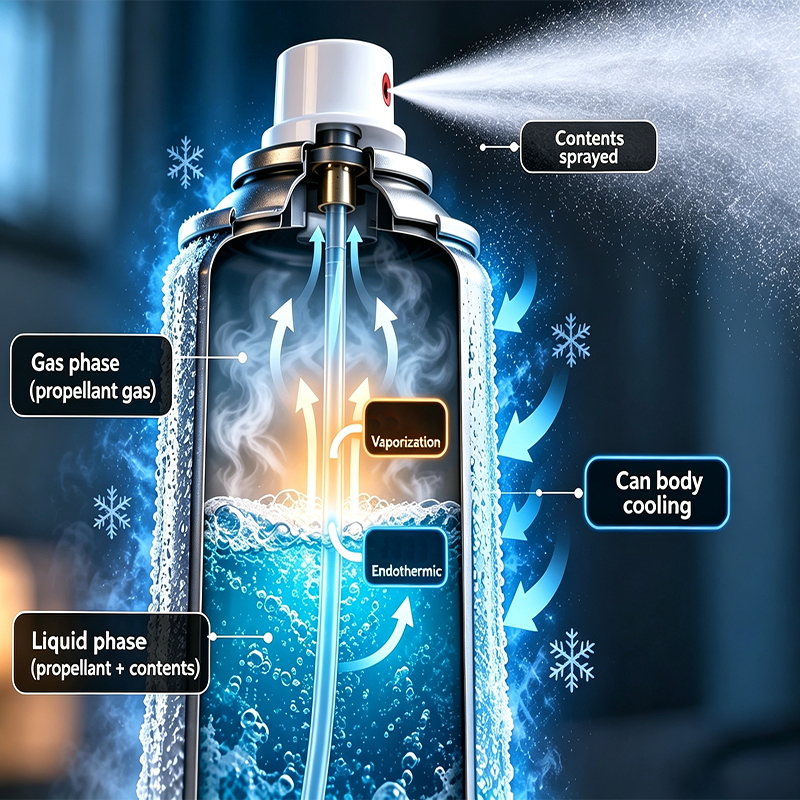
The secret lies inside the can. For an aerosol product to keep spraying, besides the contents, the valve and the nozzle, there is one very important player: the propellant.
When you press the actuator, the valve opens and the pressure inside drives the contents out. As the product keeps spraying, conditions inside the can change. For aerosols that use liquefied gas as a propellant, part of the liquid propellant continuously vaporizes to help maintain the internal pressure.
And when a liquid turns into a gas, it needs to absorb heat. Where does the heat come from? Part of it comes from the can body and the surrounding environment — and so the can in your hand starts to feel cold.
Are the “Tiny Droplets” on the Can a Sign That It’s Leaking?
Many people start to worry at this point: “Wait, why is the can wet?” Don’t rush to suspect a leak.
If the can temperature drops low enough, water vapor in the surrounding air can condense into tiny droplets when it meets the cold can wall. It is a lot like taking a bottle of ice-cold drink out of the fridge in summer — the bottle is not leaking; the water comes from the air.
So when an aerosol can appears to “sweat” after continuous spraying, what you are seeing is essentially condensation caused by the cooling of the can.
So If You Keep Spraying, Will It Really Freeze?
If an aerosol keeps releasing quickly, the can temperature may indeed keep dropping. Under the right conditions of temperature and humidity, the moisture on the can surface could even go one step further and form a layer of frost.
But here is something interesting: as the can gets colder, it also affects the vapor pressure of the propellant inside. As the temperature falls, the pressure changes along with it. That is why you may notice that, after spraying continuously for some time, the spray pattern is not quite the same as when you started.
So next time you give an aerosol can a long, steady “psssst—” and suddenly wonder why it feels more and more icy, don’t suspect it of secretly switching to cooling mode. The temperature change you feel is tied to the physical process taking place inside the can.
Behind an ordinary-looking aerosol can — from the moment you press the actuator to the contents continuously spraying out — pressure, vaporization and heat exchange are all happening at the same time. That simple “psssst—” is really not as simple as it seems.
Post time: Oct-10-2026